

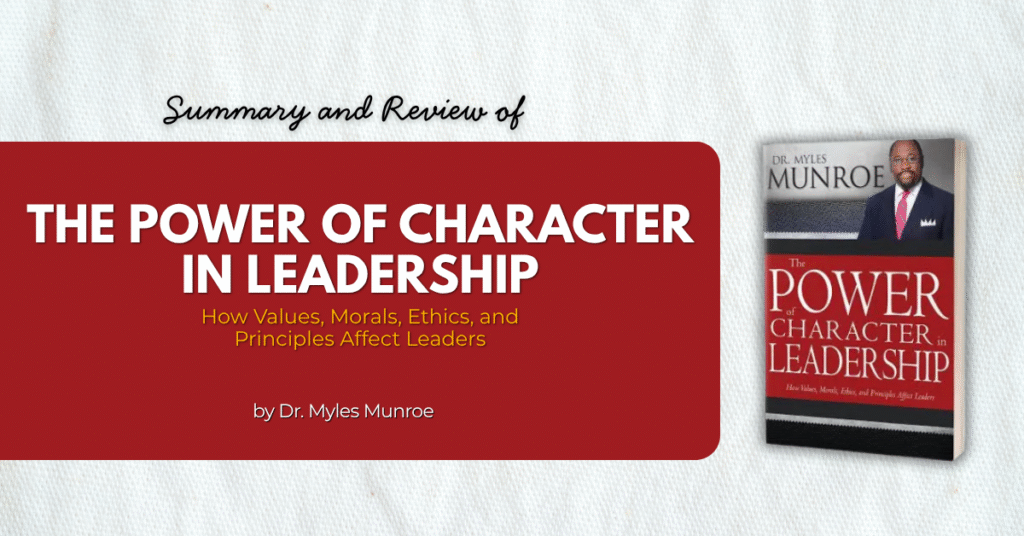
I used to think a lot about why some leaders rise so fast… and still fall just as quickly. Not because they weren’t gifted. Not because they lacked vision. But because something deeper wasn’t solid. That’s exactly what The Power of Character in Leadership by Myles Munroe addressed. This book doesn’t just show you where you are, but quietly asks who you’re becoming.
One of the strongest truths I learned from the book is that leadership is not only sustained by talent, charisma, or even vision. It is sustained by CHARACTER. This is not the kind we perform in public, but the kind that we hold dear in private, when no one is watching.
Dr. Munroe talks about the crisis of character in leadership, and it’s hard to ignore how real that is. We’ve all seen people rise, sometimes brilliantly, and then fall in ways that undo years of influence. And while it’s easy to think of “leaders out there,” this book brings it closer, to you and me. It reminds us that without the right foundation, anyone can drift.
Let’s dive into some of the key lessons.
Part 1: How character is really formed
This section confronts a truth most people don’t like to admit: leadership failure is rarely about lack of skill; it is usually a result of lack of character.
Myles Munroe makes it very clear that talent, charisma, intelligence, or even vision cannot sustain a leader. They can open doors, but they cannot keep them open. What keeps a leader standing, especially when pressure, success, or temptation shows up is character. Many leaders don’t crash because they weren’t gifted enough, but because they weren’t grounded enough. You can build something impressive on the outside while slowly collapsing on the inside.
A relatable way to think about it: You might be doing well publicly, school, work, leadership roles, but privately, you cut corners, avoid accountability, or compromise small values. Those “small things” are actually cracks forming in your foundation. Character is like a personal security system. It protects you not just from external pressure, but from your own weaknesses. Without it, success becomes dangerous.
Ponder on this – if people described your character, not your achievements, what would they say?
Part II: The Source of Moral Leadership
Here’s a powerful question: Where does character actually come from?
It was broken down into three layers: What you believe, what you value, and what you serve.
Your beliefs shape your values, and your values shape your actions. So leadership isn’t first about what you do, it’s about what is happening inside you consistently.
For example:
If you believe success is everything, you may justify unethical shortcuts.
If you value integrity, you’ll choose differently, even when no one is watching.
Munroe also emphasises that principles are not optional tools, they are laws. Just like gravity works whether you believe it or not, principles like honesty, discipline, and responsibility have consequences when ignored.
This part becomes very practical when applied to everyday life:
- How do you behave when no one is checking?
- What do you prioritise when things get hard?
- What do you protect: your image or your integrity?
Leadership is not just personal; it spreads.
Part III: Personal Character Development
This section becomes very introspective and honest. It moves from theory to self-examination and growth. Character isn’t automatic, you build it intentionally. And one of the biggest tests of character is temptation. Not always big, dramatic failures, but subtle ones like cutting corners, being inconsistent, letting emotions control decisions, choosing convenience over discipline. Every decision you make is like writing a sentence in your life story. Over time, those sentences form your character.
Some of the qualities of principled leaders include self-discipline, integrity, consistency, and responsibility. What makes this part relatable is how it highlights everyday behaviors: Being late repeatedly, avoiding responsibility, reacting emotionally; these things quietly weaken leadership.
One powerful takeaway here is: You don’t suddenly fail; you gradually drift. And the opposite is also true: You don’t suddenly become strong; you build strength daily.
Part IV: Restoring a Culture of Character
This final part is both hopeful and challenging. It acknowledges something real: People fail. Leaders fail. But failure doesn’t have to be the end. Munroe introduces the idea of “falling up”, that is, learning from failure, rebuilding your values, and becoming stronger from it. He emphasises that character can be restored, integrity can be rebuilt, but it requires honesty, responsibility, and change. He also talks about aligning your vision with your values. Because having a big dream without strong character is dangerous. You might achieve it, but lose yourself in the process.
This part expands beyond individuals to society. If leaders lack character, systems break. Trust disappears. People become skeptical. And you can see this in real life, people often question leaders, institutions, even success itself, because trust has been broken too many times. If we want better leadership, we need better character, starting with ourselves.
Final Reflection
The whole book can be summed up in one honest thought: You can build influence, success, and visibility, but only character determines whether it lasts.
Now ask yourself:
- Who am I when no one is watching?
- What am I building my life on?
- Am I becoming someone people can truly trust?
Never forget this: leadership is not just what you achieve, it is who you become while achieving it.