

Dami

Was I Ageing, or Was the World Changing?

Was I ageing, or was the world changing? This question crossed my mind when a friend shared a story. I was stunned by what I heard: a young person diagnosed with diabetes. As I listened, unease settled in. Was I really ageing that fast, or was the world around me changing at an alarming rate? I understand that several factors, including genetics, environment, and lifestyle, influence our bodies. But as I looked around, I saw more and more young people struggling with health issues that were once rare in their age group. Obesity, hypertension, mental health concerns – the list goes on. It dawned on me that the world was indeed changing and fast. As I delved deeper into this question, I noticed the subtle yet significant shifts in our lifestyles. We spend more time indoors, glued to our screens, and engaging less with nature. Our diets have become increasingly processed, and our stress levels have skyrocketed. It’s no no wonder that health conditions that were once typically associated with older adults or rare in youth are now being diagnosed or observed frequently in younger populations. But we can choose to refuse to accept this as the new norm. I believe that we can take control of our health and well-being by making intentional choices. It starts with small changes: taking a daily walk, cooking a home meal, or making time to rest and sleep deeply. These habits may seem insignificant, but they can transform our lives tremendously. It won’t be easy, and it won’t happen overnight. But I know that it is possible. So, am I ageing, or is the world changing? I say it’s a bit of both. But more importantly, I say it’s time for us to take action. Let’s make a pact to prioritize our health. We have just one life to live, remember? And if you are a Gen Z  and tempted to say, “Na something, go kill a man,” remember the pain and waste of resources that sickness comes with. Also, remember that your loved ones will be involved if illness strikes. A life of vitality is worth more than a viral joke. Health is wealth; don’t gamble with yours. “Beloved friend, I pray that you are prospering in every way and that you continually enjoy good health, just as your soul is prospering.” – 3 John 1-2 (TPT) We are a wise generation who understands that our health is required to carry out our divine assignment. This is where we belong!

Was I Ageing, or Was the World Changing? Read More »

Blog

Do You Know The Palm Tree?

Whenever the palm tree is mentioned, the plant that produces oil is what comes to my mind, so I believed I know the palm tree. While studying the Scriptures and meditating on this verse that says “the righteous will flourish like a palm tree (Ps. 92:12)”. Though it’s a familiar verse, but this time, in the ‘spirit’ of a researcher, I wondered why the righteous were compared to a palm tree of all the trees in the world. I decided to learn more about the Palm Tree. It was during my findings I got to know that the what we commonly call palm tree is actually called the Oil Palm and it’s just one of the many species of the Palm Tree. The most common types of palm trees include the Coconut Palm (Cocos nucifera), widely known for its coconuts and found in tropical coastal regions, and the Date Palm (Phoenix dactylifera), native to the Middle East and valued for its sweet dates. The Areca Palm (Dypsis lutescens), also known as the Butterfly Palm, is popular in landscaping and indoor spaces due to its feathery fronds, while the Pygmy Date Palm (Phoenix roebelenii), a smaller ornamental version of the date palm, is often found in gardens. The Queen Palm (Syagrus romanzoffiana) is commonly used in warm climates for its graceful appearance, featuring arching fronds and a smooth trunk. African Oil Palm (Elaeis guineensis) produces red palm oil. These are some essential facts about the Palm Tree. Palm trees, belonging to the Arecaceae family, are characterized by their slender, unbranched trunks and a crown of large, fan-shaped or feather-like leaves, known as fronds. These evergreen trees retain their leaves throughout the year, contributing to their year-round lush appearance. Palms are highly adaptable to warm environments, thriving in tropical, subtropical, and warm temperate climates. The palm is may bend, but rarely breaks. Depending on the species, palm trees can vary greatly in height, with some reaching towering heights of up to 200 feet. These trees are also known for their long lifespans, with some species living for over a century. Palms hold significant cultural and economic value, providing edible fruits such as dates and coconuts, ornamental beauty, and symbolic associations with peace, prosperity, and spiritual growth. Their unique and iconic structure makes them a defining feature of many landscapes around the world. This verse draws a powerful comparison between the life of the righteous and the qualities of a palm tree. Just as the palm tree is known for its resilience, ability to thrive in challenging environments, and its evergreen nature, the righteous are seen as people who remain steadfast and continue to grow spiritually even in difficult circumstances. The palm tree’s deep roots and upright, unshakable stature symbolize the stability and strength of those who live according to righteous principles. Furthermore, the palm tree’s ability to flourish in barren, desert conditions echoes the idea that the righteous are sustained by inner strength, rooted in faith, and nourished by a deeper spiritual connection. Just as the palm can live for many years, bearing fruit and offering shade, the righteous lead lives that are enduring, fruitful, and a blessing to others, embodying peace and prosperity. Can you catch a glimpse of what the Word of God says about you flourishing as a palm tree? Don’t play small! Thrive! Flourish! GROW! Glow! Excel! This is where we belong!

Do You Know The Palm Tree? Read More »

Blog

I’m Not Dumb – Part 2

Growing up as the daughter of a talented fashion designer, people often assume I’d follow in her footsteps. But I knew from a young age that fashion design wasn’t my calling. I love very classy dresses, but making them seemed like rocket science to me. Does this mean I’m dumb? Definitely not! This revelation of my disinterest in fashion design always leave others puzzled especially considering the potential for fashion design. But I crave excellence and don’t want to invest my energy on a profession I cannot thrive in. The Truth About Career Choices Being a fashion designer’s child doesn’t guarantee success in the field for me, just as being an engineer’s child doesn’t predetermine the child’s success as an engineer. I commend parents who genuinely wants the best for their children, and choose the career they feel is best for them. However, it isn’t the best when parents impose their wills on their children, not minding the child’s interest. Parents are stewards, accountable to God for their wards. Your background, parents’ occupation, and personality may spark expectations, but it is essential to prioritize God’s design for your life. Choosing a career that misaligns with your purpose is an abuse of God’s design – an abuse of yourself. As God’s creation, our career choices should align with what we are created or designed for. Others’ opinions are secondary, serving only to confirm God’s revelation to you. Jesus said, “I am the vine, you are the branches. If a man remains in me and I in him, he will bear much fruit; apart from me you can do nothing.” (John 15:5, NIV) Just as a branch thrives only when connected to the stem, our lives flourish when rooted in God. Take time to reflect on your gifts, talents and abilities. Seek God’s guidance and direction. Your future is worth it. Photo Credit: AI

I’m Not Dumb – Part 2 Read More »

Book Summaries

I’m Not Dumb – Part 1

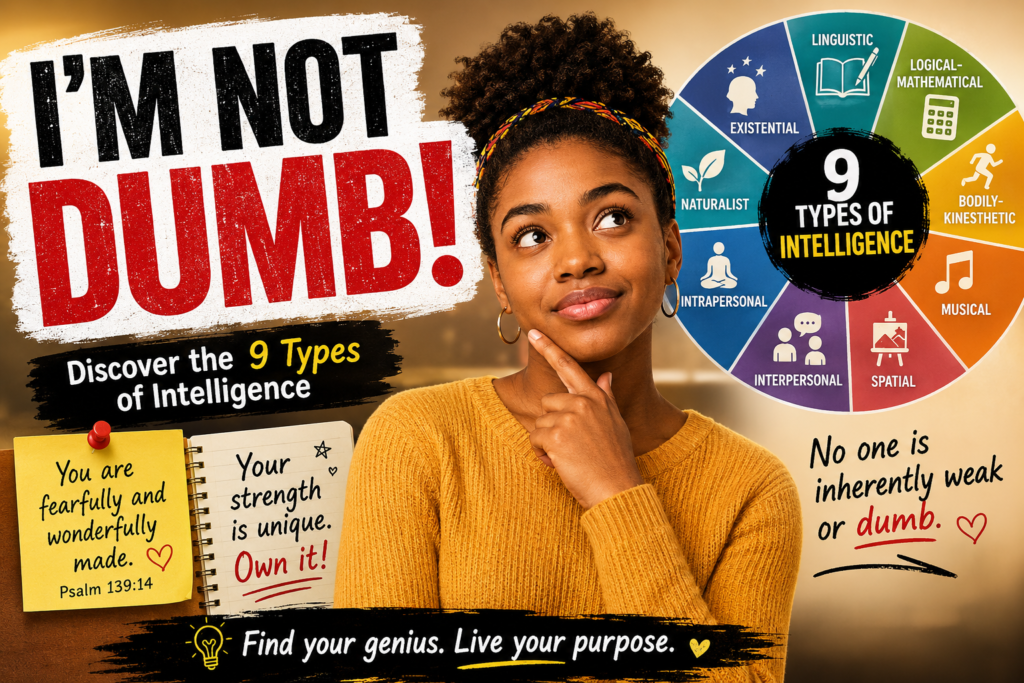
No, I’m not, and neither are you. I doubt if anyone is. In high school, Physics was a thorn in my flesh. So, when I see people, especially ladies, excelling in physics, I’m impressed, but sometimes I feel inferior. Was it my fault? Not entirely. In our society, we often judge a child’s intelligence based on their performance in “tough” subjects. For centuries, the concept of intelligence has been narrowly defined as solely academic achievement. However, renowned American psychologist Dr. Howard Gardner’s “Theory of Multiple Intelligences” challenges this notion. He identifies nine types of intelligence, suggesting each person has multiple intelligences. Let’s explore them: 1. Linguistic Intelligence: They have highly developed oratory skills, effectively using words; they’re word and language smart. These are writers, storytellers, etc. 2. Logical-Mathematical Intelligence: They’re highly reasoning, calculating, and solving puzzles; they’re numbers and reasoning smart. Think Albert Einstein. 3. Bodily-Kinesthetic Intelligence: They communicate through body language, coordinating their minds with their bodies, e.g., sportsmen, dancers, actors. 4. Musical Intelligence: They’re music-smart, sensitive listeners. (Not all singers are musically intelligent.) 5. Spatial Intelligence: They’re picture smart, environmentally aware, drawing and designing effectively, e.g., artists, sculptors, interior decorators. 6. Interpersonal Intelligence: They enjoy interacting with people, are people smart, give and receive mentoring conveniently, and connect with others effectively, e.g., teachers. 7. Intrapersonal Intelligence: They’re naturally self-motivated, disciplined, and prefer independent study, e.g., spiritual leaders, coaches. 8. Naturalist Intelligence: They’re nature smart, having a natural love for nature, e.g., botanists, chefs. 9. Existential Intelligence: They tackle life’s tough, deep questions about human existence, e.g., spiritual leaders. According to the dictionary, “dumb” means lacking intelligence. Having reviewed these nine types of intelligence, we must know that no one is weak or dumb. Most people feel unfulfilled because they aren’t doing what they’re naturally good at. They’re trying to be someone they’re not designed or wired to be. The Bible reminds me, “… I am fearfully and wonderfully made; marvelous are Your works, and that my soul knows very well.” (Psalm 139:14, NKJV) Don’t feel intimidated by someone else’s strength and uniqueness. Instead, identify yours and develop it until it places you before people who matter. Of these nine types of intelligence, can you identify yours? Keep in mind: “For we are God’s handiwork, created in Christ Jesus to do good works, which God prepared in advance for us to do.” (Ephesians 2:10, NIV) Reflect on your strengths and interests to discover your unique intelligence. Keep being excellent!  

I’m Not Dumb – Part 1 Read More »

Book Summaries

Experts Are Not Always Right!

Have you heard about the story of the automaker who tasked experienced engineers to reduce car weight, only to be told it was impossible? But then, a team of younger, less experienced engineers came along and made it happen! Read the summary: In the 1970s, soaring oil prices prompted the government to mandate car fuel efficiency. A leading automaker tasked a team of seasoned engineers to reduce vehicle weight drastically. Despite their expertise, they concluded that lighter cars were impossible to build due to cost and safety concerns. Their conventional thinking limited their solution. In a surprising move, the automaker reassigned the challenge to a younger, less experienced engineer team. With fresh perspectives and a can-do attitude, they successfully reduced the car’s weight by hundreds of pounds, proving that innovative solutions can emerge when possibilities are embraced. Their secret? They believed it was possible. The Lesson Don’t let traditional thinking hold you back from achieving greatness. Allow yourself to: – Challenge assumptions – Push boundaries – Explore fresh perspectives – Foster creativity – Embody a can-do attitude So, go ahead! Challenge the status quo, and unleash your full potential. You got this! Photo Credit: AI

Experts Are Not Always Right! Read More »

Get Inspired