

life lessons

The Space Between What Happens and How You Respond: A Lesson from Viktor Frankl

About two years ago, during a course I was taking, it was my first time hearing about concentration camps. Concentration camps were places where large groups of people were forcibly held and confined, usually because of their ethnicity, religion, political views, or other targeted identities. During World War II, they were most infamously used by Nazi Germany as part of the events of the Holocaust. People were kept in overcrowded, harsh conditions with very little food, poor sanitation, and limited freedom. Many were subjected to forced labor, and millions lost their lives as a result of the conditions and systematic violence. So we were talking about ethics and some of the extreme things humans have gone through in history, and I remember a few of the stories touched me deeply. It honestly made me pause and wonder how situations like that were ever allowed to happen in the first place. It made me wonder how anyone could ever justify or normalize inflicting such an unquantifiable level of pain on another person. But that’s not the subject of discussion for today. When people talk about World War II, the focus is often on the war itself, the fighting, and the massive loss that came with it. But tucked inside that history is something many people don’t really talk about. Despite the harsh conditions people were subjected to, some persons didn’t give up on life. I know a lot of what happened there wasn’t just physical suffering, but also the loss of identity, freedom, and basic dignity. But in the middle of that reality was a man named Viktor Frankl. Let’s talk about Viktor Frankl. Before the war, Frankl was a neurologist and psychiatrist in Vienna. He spent his early years studying the human mind, particularly what gives life a sense of purpose. Then the war interrupted everything. He was taken into a concentration camp along with his family. Over time, he lost his parents, his brother, and his pregnant wife. The life he had built disappeared piece by piece. He moved through multiple camps and lived under conditions defined by hunger, uncertainty, and constant exposure to suffering. Yet even there, he paid attention, not just to what people were going through, but to how they responded to their experiences. Viktor noticed that, while many people were overwhelmed by the conditions, some still made small, intentional choices about life. Someone would share food even when they barely had enough. Someone would offer a word of comfort to others, even when they were in pain. These actions didn’t change their situation, but they revealed something about the people making them. That observation led him to conclude that even when circumstances are extremely bad, there is still a point at which a person decides how to respond. You have a choice. Yes, you do. Viktor described it as a space between what happens and what you do next. After the war, Viktor returned to Vienna and began rebuilding his life. He continued his work in psychology and developed an approach called logotherapy. Logotherapy is a form of therapy based on the idea that finding meaning in life is the central human drive and a key source of resilience, even in suffering. He also wrote Man’s Search for Meaning, where he documented both his experiences in the camps and the psychological insights that came from them. The book has remained widely read because it speaks to something fundamental about being human. When you reflect on his story, it naturally brings your attention back to your own life. Most people are not facing the kind of extreme conditions Viktor endured, but that doesn’t mean life feels easy. Challenges still show up, plans don’t always work out, relationships can be complicated, and there are moments that feel your world is crushing right before your eyes. In those situations, it’s common to react quickly. Something happens, and the response follows almost immediately. It can feel automatic. But Viktor’s perspective suggests something slightly different. There is a brief moment, sometimes barely noticeable, where a decision is made. It might look like choosing how long to stay in a negative spiral after something goes wrong. I used to be very guilty of this. It might be deciding whether to speak to yourself or others with harshness or with patience. It might be recognizing when a reaction is coming from habit rather than intention. These are not dramatic decisions, but they are consistent ones. Over time, they influence how you experience life. I am not saying you should ignore how you truly or pretend everything is fine. Viktor’s work does not dismiss pain; it acknowledges it directly. His point was that even within difficult experiences, you still have a level of control. You can feel frustrated and still decide what to do next. You can feel disappointed and still choose how you move forward. You can feel uncertain and still take your next step. Viktor’s life shows that what’s happening around you doesn’t fully decide what happens within you. He could have given up on life like most people did. We wouldn’t blame him if he had. But do you know that instead of trying to control everything outside, your attention can shift to how you respond on the inside? That kind of awareness gives you control and helps you respond better. And over time, it can shape the way you live your life. Take this as a reminder not to let what’s happening around you control how you respond to life. I hope this blesses you. Rooting for you, always.

The Space Between What Happens and How You Respond: A Lesson from Viktor Frankl Read More »

Get Inspired, , , , , , , , , , , , , , , , , , , ,
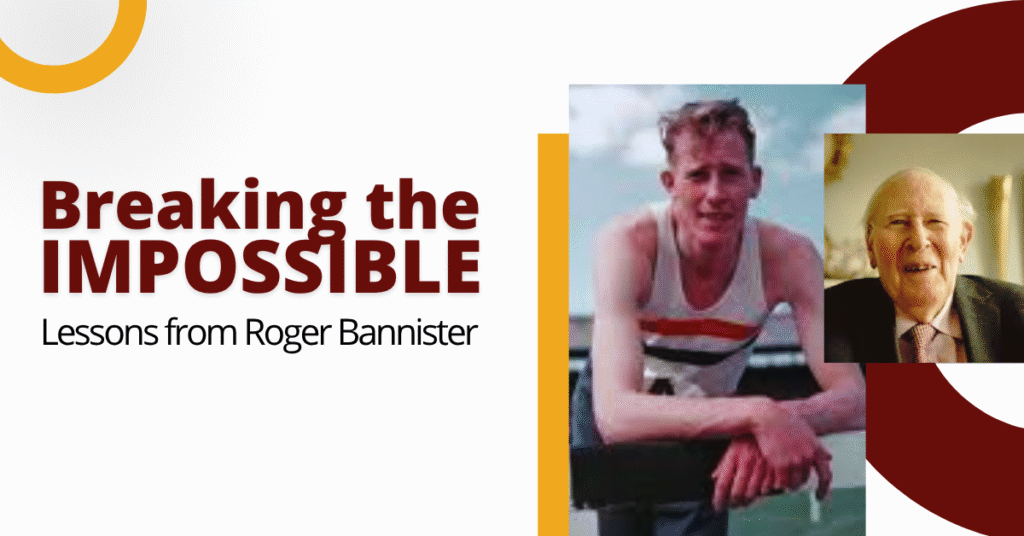
Breaking the Impossible: What Roger Bannister Teaches Us About Our Limits

I saw this beautiful quote: ‘Limits exist only until someone decides to challenge them.’ It perfectly describes the story of the man I’m about to share — Roger Bannister. I recently came across the story of Roger Bannister, and it completely blew my mind. Who is he? You may want to ask. Roger Bannister was a British medical student who, on May 6, 1954, became the first person in history to run a mile in under four minutes. Despite training minimally while studying to become a doctor, he finished in 3 minutes and 59.4 seconds. Here’s the back story. In the early 1950s, the four-minute mile was widely considered an unbreakable physical limit. Doctors, coaches, and athletes believed the human body simply couldn’t handle the speed and endurance required. Some experts even warned it could cause the heart to explode or lead to collapse. Scientists wrote papers, experts debated, and the world collectively agreed: it was impossible. And then Bannister did it. He didn’t just break a record, he shattered a belief. Within years, can you believe that dozens of people did same? Today, over 2,000 athletes have run a sub-four-minute mile. His feat didn’t just change athletics; it changed what people thought was humanly possible. He proved that many limits exist only in our minds, until someone dares to challenge them. And that is what made him stand out. There’s something quietly revolutionary in that story. Bannister didn’t wait for permission, for the world to believe in him, or for conditions to be perfect. He took a bold step. He acted on what He believed was possible. He ran. He focused on what he could do, not what everyone else said he couldn’t. And in doing so, he shifted the horizon for everyone who came after him. What a great way to live! I find myself thinking about this in my own life. I imagine the small battles we fight every day. Maybe it’s a dream that seems too big, a skill you want to master, or just a habit you want to change. The truth is, the world may tell you “impossible” in one way or another, but impossible only becomes real when you accept it. When you act, when you take that step, you begin to rewrite what’s possible for yourself, and maybe even for someone else who’s watching. So today, I want to invite you to run your own mile. Not necessarily on a track, not literally (unless you want to, of course!), but in life. Take that step toward what feels impossible. Do the thing that makes you doubt, that scares you, that everyone else says you can’t do. The more you practice challenging your limits, the more you realise those “impossible” walls are often just ideas waiting to be shattered. Because here’s what you need to know: when you do the little things that feel right, when you push yourself just a little further than yesterday, you don’t just achieve, you become a better version of yourself. And just like Bannister, your courage to act might open the door for someone else to believe, to try, and to run their own mile. What are you doing differently today? This month? Challenge your fears, break the barrier. Go for gold. Do the impossible. Yes, you can! I hope this encourages you.

Breaking the Impossible: What Roger Bannister Teaches Us About Our Limits Read More »

Get Inspired, , , , , , , , , , , , , ,

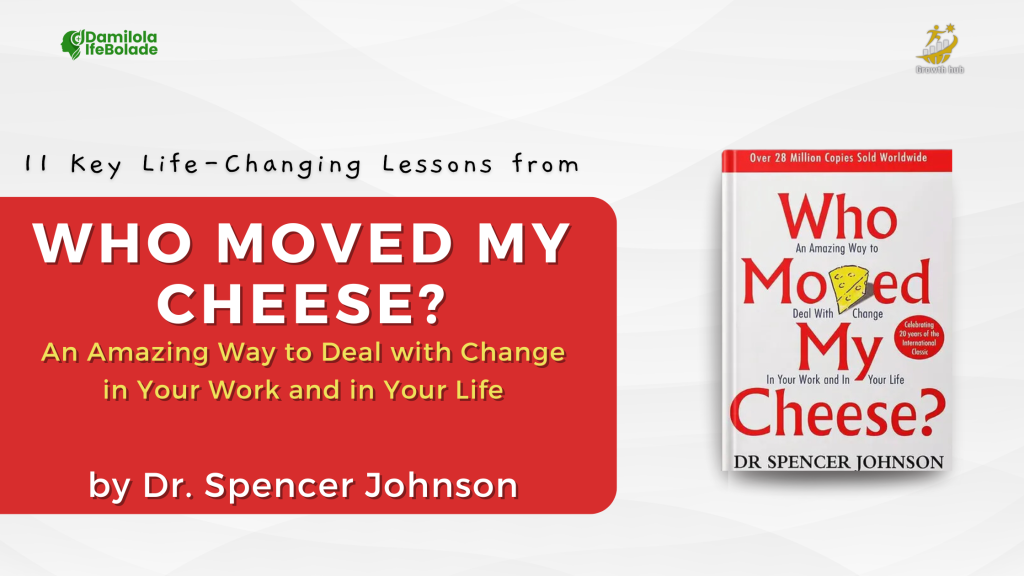
11 Key Life-Changing Lessons from Who Moved My Cheese by Dr. Spencer Johnson

It is no news that change is inevitable, yet so many of us resist its tides, clinging to the familiar while yearning for growth. If you’ve ever felt stuck or paralyzed by fear of the unknown, unwilling to move from your comfort zone, “Who Moved My Cheese?” by Spencer Johnson is a sure wake-up call. This short read tells the story of four characters – Sniff, Scurry, Hem, and Haw – each on a journey through a maze, in search of their elusive “Cheese.” But here’s the twist: the “Cheese” is a metaphor for everything we hold dear. Meanwhile, the maze mirrors the unpredictable landscapes of life we all face. As I turned the pages of this book, I found myself chuckling and sometimes nodding at the profound truths tucked into its simplicity. It’s a story that reveals our relationship with change and challenges us to look inward to see whether we sniff out new opportunities, scurry toward growth, resist in fear, or adapt and thrive. Here, I’ll share some lessons on embracing change from this insightful book. Let’s dive in! 1. What You Fear Might Never Happen Fear often paralyzes us, but most of the things we fear never come to pass. Often, breakthroughs come when you simply decide to take a step forward. Whatever it is you’ve set your mind to do, and you’re afraid of failure, ask yourself: Is this fear truly valid, or is it just my mind creating roadblocks? Instead of thinking “what if I fail?”, think “what if I succeed?” 2. Your Friends Are Great Determinants of Your Success or Failure Sometime ago, I stumbled upon a humorous video clip that cleverly pointed out: when surrounded by five foolish people, the total count is actually six.  In other words, the people you surround yourself with can either inspire you to move forward or limit you to remain in stagnation. You become the average of the closest people to you. Therefore, choose your company wisely. 3. Nothing Will Move If You Don’t Move We’ve all heard the saying “if wishes were horses, even beggars would ride.” This is a reminder that no great achievement happens solely through wishful thinking. To make progress in any area of life, action is needed. It is true that the first steps may be uncomfortable, but know that hesitation only prolongs discomfort and prolongs the process. So, it’s time you decide to take that first uncomfortable step and let the momentum build. Just start somewhere! 4. Set Your Heart on Positive ‘What Ifs’ Rather Than Negativity It’s natural for our brains to be on the lookout for threats and what may go wrong. This is because our brains are wired to keep us safe from danger. But to achieve more in life, you may need to shift your focus to the potential good that lies ahead, instead of dwelling on negatives. What if things work out better than you ever imagined? This should be your focus. Don’t dwell too long on negativity. 5. Dare to Stretch; You Have More Strength Than You Think Life’s challenges often reveal untapped strength within us. You’re capable of more than you realize – all it takes is the courage to stretch. You’d be surprised at how far you can go. Go outside your usual space, go a step further. Dare to stretch! 6. Picture the Future You Desire Have you ever heard the saying, “What the mind can conceive, the hands can achieve”? It’s a powerful truth. When you vividly imagine your desired future, you’ll be amazed at how it can motivate and inspire you to take action. What’s your vision for your life? What dreams do you want to achieve? Take a moment to close your eyes, visualize your goals. Write it down, post it somewhere you can see it often, and let it propel you forward. 7. No One Gives Up and Makes It Big Reading biographies and stories of great achievers has always been a great encouragement to me. That’s why I have a blog session for people who want to Get Inspired by other people’s stories of resilient. Every great achievement story involves consistency and persistence. Giving up is a surefire way to miss out on what could have been. So, even when the journey gets tough, keep pressing on. You cannot make it big if you give up! 8. Change Doesn’t Seek Permission Change is inevitable; it doesn’t wait for an invitation, neither does it seek permission from anyone but it will surely come. The question is, will you prepare for it or be caught off guard? While many soar on the winds of change to do big stuff, others crash. The best thing you can do is stay alert and ready to adapt. Change will always come, prepare for it. 9. Start Early, Start Now—Why Wait? Procrastination has always and will always be a dream-killer. The longer you wait to take action, the harder it becomes to get started. Don’t let delay hold you back from achieving your goals. While you may be dragging your feet, someone somewhere may seize that same idea in your head and get ahead of you. Why not start now? Remember, momentum is your friend. Take the first step today. 10. Let Go of the Past The past is where it belongs – behind us. Why bring it into the present? Clinging to the past can hold you back; it’s no longer relevant. Your past doesn’t define your future unless you let it. If there’s a need for corrections or restitution, please make amends and then move on. Release the past and move forward – beautiful things are ahead! 11. Laugh at Your Foolishness Transformation begins with self-awareness and a dash of humor. When you learn to laugh at your own mistakes, you’ll be amazed at how much lighter and freer you’ll feel. Instead of beating yourself up over errors, smile at your missteps, learn from them, and decide to do better. And ensure you

11 Key Life-Changing Lessons from Who Moved My Cheese by Dr. Spencer Johnson Read More »

Book Summaries, , , , , , , , , , , , , , , , , ,